Why Zagreb Has a Two-Hour Queue for a British Baked Potato
From Tamworth to Naples to Yunnan, the digital layer turns ordinary food into spectacle and queues into content.

On a hot Saturday night in Zagreb, the line snakes down the block. Phones are up. Someone films the wait, someone else pans across the crowd. At the end sits a baked-potato stand.
SpudBud serves what he calls British baked potatoes: split open, steaming, finished with beans, tuna, or grated cheese. In Britain, this is cafeteria fare, school-night cooking. Hardly glamorous. Yet in Croatia’s capital, the queue stretches for hours.
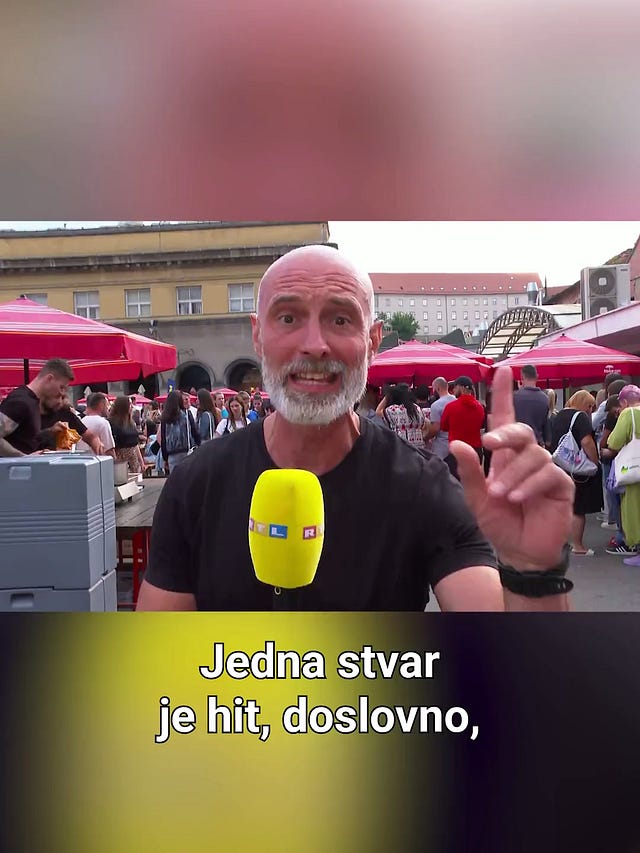
 Tiktok failed to load.
Enable 3rd party cookies or use another browser
Why?
The answer lies not in cuisine but in choreography. To understand why Zagreb is lining up for potatoes, you have to look beyond Zagreb. You have to look at Tamworth. At Naples. At Yunnan. The baked-potato queue is just the latest expression of a broader cultural logic: ordinary people, ordinary jobs, lifted into spectacle by the algorithm.
The Spudman Effect
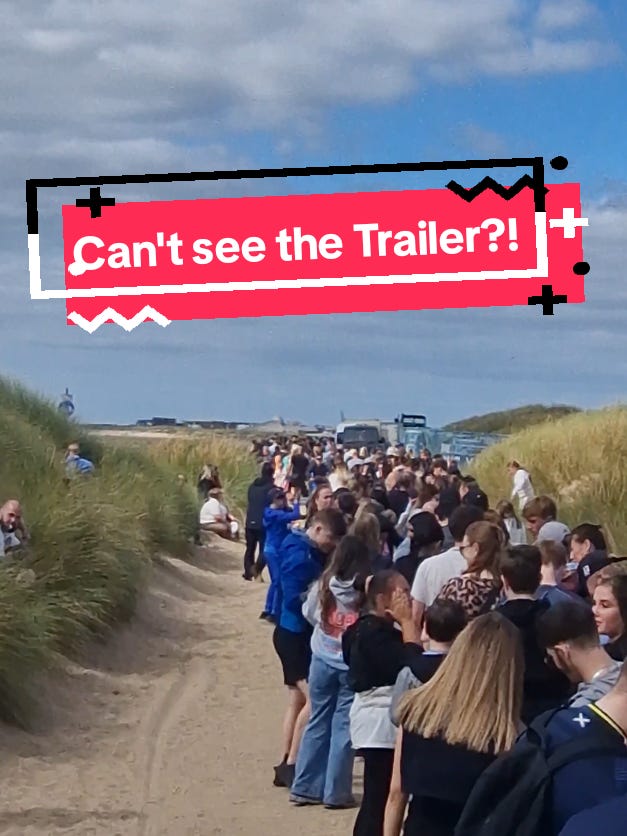
In Tamworth, a market town in Staffordshire, a jacket-potato van is rewriting the rules of fame. Its owner, Ben Newman, better known as Spudman, took over his pitch in St Editha’s Square more than twenty years ago, buying it from his father for £16,000. For most of that time it was simply a van selling foil-wrapped potatoes with beans, cheese, or chicken curry to passing shoppers. The breakthrough came not from the food but from the camera.
In 2021, Newman’s children convinced him to try TikTok. One of his earliest clips unexpectedly reached half a million views, and by the end of that year he had 120,000 followers. By mid-2022, nearly 200,000. Today, he has more than 4 million followers on TikTok, 1.6 million on Facebook, and nearly half a million on Instagram. The formula is simple: he points a camera at his daily routine, chats with customers, cracks jokes, sings, and leans into his theatrical pink-mohawk persona. The combination of friendliness and spectacle turned the van into a stage.
 Tiktok failed to load.
Enable 3rd party cookies or use another browser
As the clips circulated, Tamworth itself began to change. Queues stretched down the high street, with people traveling from across Britain and even abroad to buy a potato from the man they had seen on their screens. In January 2024, Newman gave away 1,500 potatoes in a single day, raising more than £7,000 for Kidney Research UK. Some of his videos have been viewed over 122 million times.
Celebrity visits accelerated the effect. Singer Tom Walker stopped by in February 2024, serving potatoes and performing a short set in the square, calling it “hands down the best baked potato I’ve ever eaten”. Other figures, from soul singer Teddy Swims to bodybuilder-actor Martyn Ford, followed. Each appearance became content that pushed the next one further, their fame boosting his visibility and his viral aura reflecting back on them.
By 2025, Spudman was no longer just a local vendor but a community institution. When Tamworth council proposed replacing his pitch with a flowerbed, more than 65,000 people signed a petition to keep him in place. The council relented, acknowledging that the potato van had become both an economic draw and a cultural landmark.
And the model did not stop in Staffordshire. In Zagreb, a young man watched Spudman’s rise and saw possibility. He launched his own baked-potato stall, SpudBud, borrowing the format and the playbook: cheerful banter, simple comfort food, and a steady stream of TikTok clips to turn offline queues into online spectacle. What looked like inexplicable mania in Croatia was, in truth, the export of a formula already tested in Tamworth; a modest dish transformed into a pilgrimage by algorithmic gravity.
The Queue as Content
When a video starts to go viral, like a clip of SpudBud’s potatoes, it seeds a feedback loop. Humans are wired to mirror what they see others doing. Psychologists call this social proof: in ambiguous situations, people look to others for cues on how to behave. If everyone else is lining up, it must be worth queuing for.
In digital spaces, this cascades. Economists describe it as an information cascade, where people copy the crowd not because they know the product is good, but because they assume others must know something they don’t. The queue becomes self-fulfilling: the more people film it, the more others come to join it, and the cycle repeats.
Platforms amplify this bandwagon effect. TikTok’s algorithm favors signals like engagement and immediacy. A dramatic queue signals excitement and scarcity, both of which make content more shareable and more likely to be pushed into feeds. Studies on online virality show that high-arousal emotions: Surprise, delight, even awe, significantly increase sharing. A long line snaking across a city square does exactly that: it looks like something important is happening, and people rush to capture it.
In practice, the queue itself becomes the content. Each person waiting is also filming, uploading, sharing. Their footage serves as fresh proof that this is culture in motion. Offline, a line of two hundred people for potatoes may look absurd. Online, it makes perfect sense. The line is the signal.
Naples and the Sandwich Maker
In Naples, the sandwich maker who became a global curiosity is Donato De Caprio, known to millions by his catchphrase “con mollica o senza?” (with the crust or without?). He did not begin as a street vendor. He worked behind the counter at Ai Monti Lattari, a small salumeria in the Pignasecca market, stacking rolls with mortadella, mozzarella, or fried eggplant for local customers. In 2022 he began filming simple clips of his work: bread cut open, fillings layered, crusts tossed aside when customers answered “senza.” The routine was unpolished, intensely Neapolitan, and oddly hypnotic. Within months he had more than 1.5 million TikTok followers and tourists were lining up at the shop to film their own moment with him.
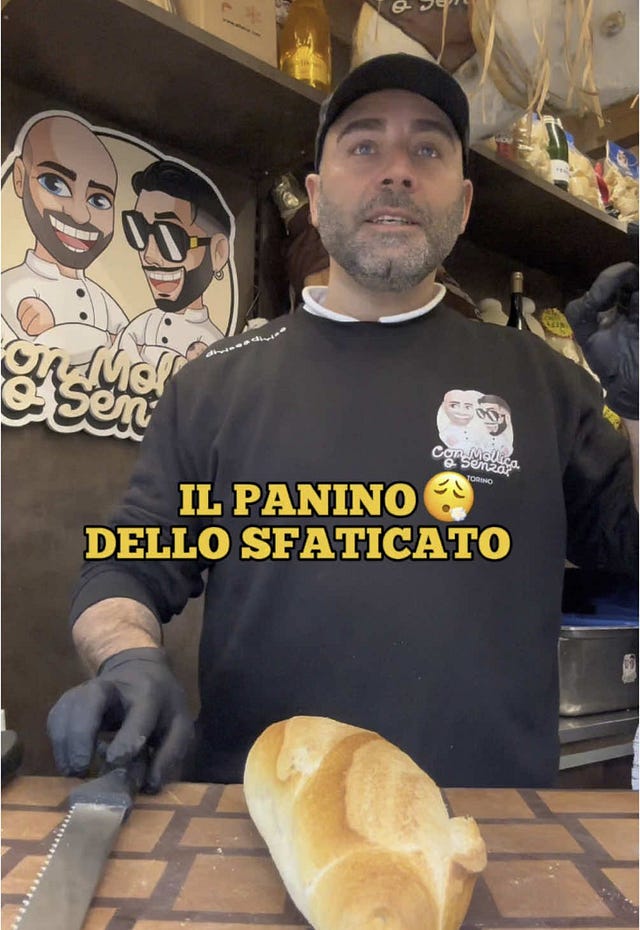 Tiktok failed to load.
Enable 3rd party cookies or use another browser
The crowds proved too much for the traditional deli. Management, unhappy with the disruption, banned him from filming, and by July 2022 De Caprio was out of a job. Italian outlets described it as a firing, though some framed it as a forced exit after the ban. Either way, the sudden viral attention had made the old arrangement untenable. His online community, however, was not ready to let him fade. Fans flooded the deli’s pages with bad reviews and rallied behind him under the cry “Free Donato.”
Support came quickly. The entrepreneur and influencer Steven Basalari offered to back him in opening his own shop. On February 19, 2023, De Caprio cut the ribbon at Con Mollica o Senza, just meters from his old workplace. The symbolism was not lost on local press. Within weeks the new shop was serving about 1,000 sandwiches a day, and De Caprio told interviewers that virtually every customer, “99.9 percent”, had found him through TikTok.
By 2024 the brand had expanded to Milan and Rome, tested a delivery-only “dark kitchen,” and in April 2025 opened in Bari. Basalari reported that the Naples flagship alone took in €3.34 million in 2024, with another €194,000 from Glovo deliveries. Group revenue reached nearly €8.83 million. On social platforms, De Caprio’s main TikTok account grew to around 4.3 million followers, with hundreds of thousands more across Instagram, Facebook, and YouTube (Il Sole 24 Ore, 2025).
The mechanics that turned a deli clerk into a destination were straightforward once you saw them. Short, tightly framed videos made the craft legible and repeatable. A location in a dense pedestrian corridor converted viewers into walk-ins. The algorithm did the heavy lifting at scale, but the line outside the door completed the loop, since each queue generated fresh waves of user-generated promotion. A camera on a cutting board, it turned out, could be as powerful as a billboard.
China’s Livestream Farmers
In China, rural entrepreneurs have turned short videos and livestreams into a powerful form of commerce, no storefront required. Take Jin Guowei, better known online as Brother Pomegranate. Once a debt‑laden fruit peddler in Lijiang, Yunnan, he transformed into a national sensation: by 2020, he had amassed 7.3 million followers on Douyin and generated 300 million yuan (about $46 million) in sales. In one livestream, he sold 6 million yuan worth of pomegranates in just 20 minutes.
His story is emblematic of a sweeping shift: rural sales efforts on ByteDance’s Douyin grew 15‑fold year‑over‑year, as live commerce became a lifeline for remote farmers reaching urban consumers directly . Today, livestreaming agriculture makes up a significant chunk of China’s broader live‑commerce boom, part of a trillion‑yuan market in 2020, with 388 million users, or 40% of the internet population, participating.
Brother Pomegranate is not alone. Farmers like him tap massive urban audiences with rustic authenticity, high-energy pitch, and a taste of countryside craftsmanship. In doing so, they sidestep traditional retail channels and middlemen, and livestreaming becomes both a shop and a stage.
The mechanics are the same whether in Yunnan or Zagreb: once attention gathers, the line, whether digital or physical, becomes the product. The queue is the proof.
Back to Zagreb
Which brings us back to that Saturday night line winding across the Croatian capital.
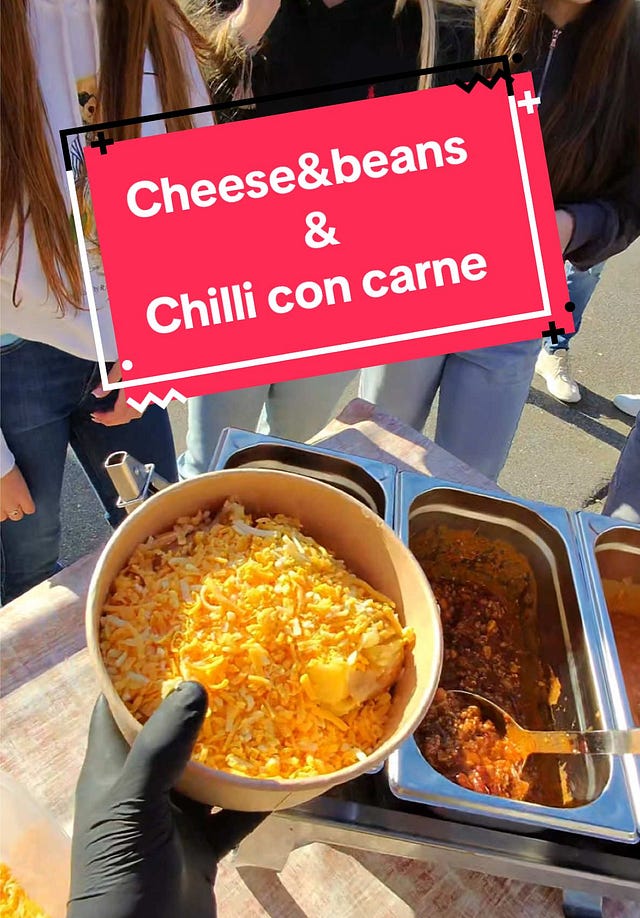 Tiktok failed to load.
Enable 3rd party cookies or use another browser
SpudBud’s potatoes are not extraordinary. What is extraordinary is the infrastructure around them. The Tamworth van, the Neapolitan sandwich counter, the Yunnan orchard, all show how ordinary food and ordinary labor are remade into destinations by the digital layer, that invisible system of feeds and platforms shaping what we see and where we go.
To understand Zagreb’s queue, you cannot just look at Zagreb. You have to look at Tamworth, where a pink-mohawk potato man made a van into a stage. You have to look at Naples, where a deli clerk turned a catchphrase into a franchise. You have to look at Yunnan, where a farmer with a camera sold millions in fruit. And above all, you have to look at the digital layer itself, the algorithmic gravity that binds them together.
Only then does it make sense that hundreds of Croatians would wait two hours for an ordinary baked potato.
The Algorithm Walks Among Us
This is the fifth in a series unpacking the digital layer; the invisible systems that guide our everyday choices. New essays drop regularly, covering everything from tourism and migration to memory, meaning, and metadata.
Previously


About the Author
Morgan Sowden is a London-based technology executive, writer, and entrepreneur with over 25 years of experience building digital platforms across media, fintech, and marketplaces. He is the cofounder of journalist.net, a global platform for freelance journalists. A former senior engineering leader at Meta and ex-CTO at several high-growth companies, Morgan has spent his career at the intersection of technology and society, from building public internet infrastructure during the Bosnian war to developing tools that support modern journalism. He still loves techno, and when not thinking about algorithms, he’s usually traveling, taking photos, or quietly watching how technology reshapes the texture of everyday life. He lives in London.
This is the longer essay exploring this topic
The Digital Layer: How Invisible Systems Shape Our Choices, Behaviors, and Realities

We live in an age obsessed with screentime. We track it, debate it, and often feel guilty about it. A higher-than-expected report from our phones can feel like a moral failure. We distinguish between productive screentime (the laptop at work) and wasted screentime